Showing posts with label Goodness. Show all posts

2010-04-11

Is God's Creation Good?

Christians frequently point to the beauty and elegance of nature as a reflection of the goodness of the creator.  And indeed nature is wondrous in many ways.  But there is a problem: many of the key underlying characteristics that lead to survival and multiplication of posterity are not those that Christians would like to ascribe to God.  These include: deception, predation, sickness, disease, death, fear, pain, poison, starvation, ruthlessness, and so on.  These properties are not simply add-ons to nature, but are deeply embedded in its design and fabric.  Let me illustrate some of these:

Fear and pain.  One of the great evils in this world is to be tormented by fear and pain.  Yet fear and pain play a crucial role in nature, spurring animals to find food and avoid predators.  A gazelle living in fear of mountain lions and wolves will remain alert and has a far better chance of survival than one without this fear.  The fear of the pain of being ripped apart will drive it to flee a pursuer with the last drop of its strength.   Furthermore, when prey are scarce, pangs of hunger will drive a wolf to seek prey with all the strength it can summon.  Fear and pain are like a force of nature, propelling the life cycle onward.

Predation.  Much of the diversity and beauty of nature is a result of each animal being optimized for a niche both in what it eats and in the ways by which it escapes predators.  For instance, panther chameleons are slow-moving tree-climbers that are experts at creeping up on insects and then grabbing them with their tongues that are almost as long as their bodies.  Cheetahs' camouflage and litheness enables them to silently creep up on a herd of impalas and catch one in a high-speed chase.  The impala, on the other hand, with its large eyes seeing in almost all directions and keen ears is highly suited to escaping swift predators.  Without predators, many of the impala's tightly honed features would be superfluous.  If the cheetah ate grass, its features would be superfluous, if not harmful, and it would do much better in a form similar to an impala or a cow.  The key reason for diversity and variety in the animal kingdom is the enormous number of techniques animals have developed both for avoiding being preyed on and for preying on other animals.  The predator-prey relationship is a harsh but necessary component of the beauty of nature.

Death.  Death is an essential part of life for many creatures.  Consider flies.  An apple falls on the ground and a fly lays eggs on it.  The eggs hatch, become maggots and consume the apple.  Once the apple is gone, either the maggots die or they must escape.  Well their plan is to escape by becoming flies which look for more fruit in which to lay eggs.  Imagine flies never died; their numbers would keep increasing with each fruit that fell until the world was 3 feed deep with swarming flies.  But this applies not only to flies, consider caterpillars: they eventually become butterflies whose job is to mate and lay eggs.  Some butterflies have no mouth for eating so living forever is out of the question.  The incredibly elegant and complex reproductive and mating system for animals is based on the inevitability of death.  Without death, any species the reproduced would eventually cover every square inch of the earth's surface.

If nature sings the praises of its Creator, what is it telling us about him?  One must look not only at the love a mother shows her offspring, but also at the cuckoo that kills the other chicks in its nest and the parasitic wasp that lays eggs in a caterpillar that eventually devour the caterpillar alive.  What does it tell us about the Creator that animals (and humans) are designed to suffer fear and pain and to starve and die?  What does it tell us that the winners in the animal kingdom are typically the strongest, fittest, most fertile, most well-camouflaged, most deceitful and most ruthless?  God must value those qualities highly since he made them the criteria for success in his creation.

Now here is the answer that puts all these worries about God to rest.  These bad characteristics are simply a result of The Fall; when Adam and Eve disobeyed God, and God cursed the creation.  Since then not only have women suffered pain in childbirth and men had to work by the sweat of their hands, but death and pain and all bad things we see entered creation.  So these bad things we see do not reflect God's plan or his original creation, rather they are just his punishment on earth for man's sin.

As a myth this might be a fine solution for taking God off the hook for designing all the cruel ways in which animals kill and devour each other.  But it fails when it claims to be historical or scientific.  It implies that before the fall that the world was good and these cruelties, including death, were absent.   Cheetahs could chase impalas to stay fit, but they better not sink their teeth into their necks.  For that matter, since impalas don't need to fear cheetahs, they could stop looking around them and grow fat eating grass.  It means that flies and caterpillars better not be multiplying.  Actually no animals should mate unless ways of populating other planets were devised.

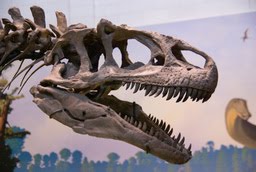
There is another problem too: the fossil record clearly records the death of animals for hundreds of millions of years.  That is far longer than anyone would claim humans were around, and far before the fall.  And life and death back then was surely no pain-free picnic.  A fossil (right) that struck me, in the Carnegie Museum of Natural History, has been kept in the same pose in which it was excavated showing the dinosaur's neck arched back in its death throes, perhaps as it is buried alive in burning ashes.  And no one can tell me animals didn't suffer pain when chomped in half by the enormous teeth of a TRex or belly slashed open by a deinonychus.    For that matter, what kind of loving, caring creator would bestow an enormous dagger on the foot of a deinonychus?  What was God thinking he would do with it?

It is clear that nature as a whole does not now, nor has in the past, embodied the loving, caring, self-sacrificial  ideals we would like to ascribe to God.  Rather, if it were an intelligent mind that devised the deceitful and brutal ways for animals to catch, kill and eat each other, that mind certainly lacks empathy and care for the downtrodden and weak.  And perhaps taking an intelligent mind out of the creation equation provides hope.  We don't have to accept that humans are doomed to be cruel or evil by nature.  Rather the intelligent minds are now, us!  We have an ability to reason and to empathize with those that suffer.  We do not have to model society after the survival of the fittest model.  Instead, perhaps dignity, freedom and compassion can replace eat-or-be-eaten.

2008-03-30

Does the Atonement Make Sense?


Atonement is an explanation for how God can forgive sins. It is often presented as penal substitution: Christ took the punishment that we deserve as sinners when he died on the cross. He payed the debt we owe to God for our sins. Thus God is free to forgive our sins and still satisfy the blood requirements of justice.

Here is the problem: say person B commits a horrible crime against person A (for example, say he kills all of person's A's family). Naturally when B is caught, A wants him punished for his crime. Then person C says: I'll take the punishment instead of person B, so you can let B go free. So person C is executed instead of person B and justice is statisfied, is it? Is justice really blind to who it punishes? Even if person A decides to forgive person B and gives up his demand for punishment of B, what is accomplished by person C being executed in B's place? Or consider this, person A says: you can let B go and execute me instead of him.

What a strange idea of justice: a crime is committed and someone has to die for it. But it does not matter who dies: either the ciminal or an innocent, willing substitute, even the victim or the judge. Atonement lies at the heart of Christianity, and yet when examined closely one must ask: What is moral, good or just about this teaching? Why can't God, like us, simply unconditionally forgive?

2007-09-08

Humanism


I have started reading about humanism. A good summary is the Humanist Manifesto III. It is interesting how it is diametrically opposed to much of what I learned growing up in a Christian household. Humanism, as its name implies, has a very positive outlook on humankind, whereas Christianity takse the opposite approach: as fallen creatures we are essentially evil and can do no good unless enabled to do so by God. (Depending on one's brand of Christianity this is emphasized to a greater or lesser degree.) So which attitude is right?


Everyone would agree that humans can do much evil; that is evident by looking current or historical events. But as humans are we condemned to committing evil? Humanists are the optimists and say: No, we are capable, given the right philosophy, of doing great good and living good and productive lives. Christianity is the pessimist in this regard: due to Adam and Eve eating the fruit we are lost in a vicious circle of evil begetting more evil. Only God's intervention can enable us to do good.


Is there any way to decide between these competing claims that good is a result of human motivation or only as a result of divine intervention? Unfortunately there is no way to determine if any action was caused by divine intervention. Good (and evil) actions can be done as a result in a belief in God, but a belief in God is much different than God actually intervening. So a choice between these isn't going to be made on physical evidence (although a choice might be made on a lack of evidence for supernatural intervention).


So it seems to me that a lot depends on a choice in attitude. It is either:


  • I can live a good life on my own and will strive to do this, or

  • I can't live a good life on my own. I will need to rely on God and he will make me good.

Which of these will be more successful in living a good life? I don't think it is the second. While it might seem attractive by its apparent modesty, I think it is a false modesty. By denying our ability at the outset it instills defeatist attitude. While it is true that none of us is perfect, that doesn't mean we can't be good, despite Christian claims to the contrary.


I believe the first option will lead to a better life. By pursuing the very things that make us human: rationality, creativity, compassion and love, we can live a good life. The good life is thus the fulfillment of being a human. Surely that is worth striving to achieve.

2007-01-09

Does God's Goodness Matter?


In my first post of this blog I argued that God, as presented in the Bible, is not good due to his many evil actions. I have not heard any good arguments countering this. But an important question is: why does it matter if he is or isn't good?

The reason it is important is that if Christianity is true, then at the very least its claims must be interally consistent. Truth cannot contradict itself, but falsehood can and often does. Now a chief claim of Christianity on which it recommends itself to the world is that God is good and he loves people. Evangelists proclaim his goodness to the heathen telling them to seek his forgiveness. When Christians meet together they worship and praise God for his goodness. But how can this be? Haven't they read the Bible which clearly witnesses many of God's evil actions? Aren't they concerned about this major inconsistency? Is truth of no value?

2004-12-03

Is God Good?


Introduction

Christians frequently proclaim the goodness of God. But what exactly do we mean when we say God is good? We have a general idea of what it means for a person to be good, but do the same or different criteria apply to God? Once we can determine what it means for God to be good, then does he satisfy the criteria? One answer is to ignore the evidence and claim dogmatically that God must satisfy the criteria and so be good. But any religion could do the same with their God. A better way is to look at God’s recorded deeds in the Bible, and determine from these whether or not he is good. This is what I will investigate in this essay.

First let me explain the purpose of my question. Christians hold up God as someone to be worshiped, admired, loved and adored. Why should we have those attitudes and emotions towards God? Is it simply because he is all-powerful and creator? Surely that is insufficient. If he were all-powerful and created us to extract sadistic pleasures from us that should not inspire those attitudes. Say the devil were all-powerful, should we worship him? I would say no, despite the possibility that he might treat us better as a result of groveling before him. For me, the crucial property that God must have before I would admire him is goodness. Without this, worshiping him would be like worshiping whatever tyrant is in charge. This may benefit one, but it is surely a cowardly way to act. Hence, I will seek to understand what good must mean in application to God, and whether or not it does apply.

Human Goodness

Before one can ask if God is good, this term must be defined. I don’t intend to find an exhaustive definition, but I think a rough summary will do. I will start by exploring its meaning in application to a person. A good person demonstrates sacrificial love and care for other people and animals. He is honest, generous and merciful. He is not spiteful, mean or cruel. Goodness is a moral choice: the rejection of evil and pursuit of what is right or best towards others. There is plenty more that can be added, but this captures much of what it means except for a further stipulation that good excludes great evil. Consider the analogy of a doctor that through great effort manages to save the lives of 10 people per week, week after week. Indeed this may be a good man, but then say it was discovered that on the side he was periodically murdering one in a hundred of his patients to acquire their wealth. Even though on balance he is likely doing far more good than harm (saving many more lives than he killed), yet it is unlikely we would judge him as a good person. That is because being good is a high standard that is not compatible with his evil actions. Another interesting aspect of being good is that it never occurs in an isolated individual, but rather it is an aspect of one’s relation to other sentient creatures. If one lived in a universe with no other creatures it would be meaningless to say one is good or evil; one’s goodness is always determined with respect to others.

Divine Goodness

Given that we know that it means for a person to be good, then the question becomes: do these same criteria apply in determining if God is good? First let us look at the possibility that good as applied to God means something completely different than when applied to humans. By this we could mean that God, being so much greater than us, is governed by a completely different set of laws, or we could mean that God’s character is what defines what good means and so God is good by definition. If the first of these is true and God follows a different set of laws or protocols, then in calling God “good” we are redefining what “good” means. But “good” is already defined by common usage, and so it would be better to say God is foo, and define “foo” to be obedience to these higher laws or protocols. Then God is not good, and is something else. Well, consider the second possibility that God’s being defines the meaning of good in the same sense that the platinum-iridium cylinder in Paris defines what a kilogram is. Whatever God is or does is good and there is nothing he could do that is not good since he defines good. This may be useful for judging people, as we could say people are good in so far as they are similar to God. However, if one says God is good, this is a tautology. It is like saying John is John or the 1kg block is 1kg; true but useless statements. If God acted like the devil then he would still be good by definition. This tautological meaning of “God is good” is not something for which we could praise God, and so cannot be what we mean when we say God is good.

Next I will examine the arguments in favor of good as defined by humans applying to God. These include the many, many Biblical comparisons of God’s actions with human actions in which he is shown to be good in an analogous way to humans. God’s blessings on his people, his love for them and his protection of them are the big similarities, and in addition other properties such as faithfulness, truthfulness are what we praise God for when we think of him as being good, and these are exactly what we think of in a good person. In addition Jesus draws a very strong parallel between God’s goodness and ours, often comparing the actions of a good father with the good heavenly Father. One of his comparisons is:

“But I tell you: Love your enemies and pray for those who persecute you, that you may be sons of your Father in heaven. He causes his sun to rise on the evil and the good, and sends rain on the righteous and the unrighteous. If you love those who love you, what reward will you get? Are not even the tax collectors doing that?” (Matt. 5:44-46).

Here God’s goodness is seen by how well he treats the unrighteous, and this is held up as an example for us. We see the same criteria for goodness being applied to God and mankind. Another argument in favor of this is that it is compatible with the notion of goodness being an absolute term. If goodness is absolute, then it must apply both to us and to God.

What happens when we apply our concept of goodness to God? Indeed we observe the many good and generous things God does, starting from his creation of a beautiful world for our benefit to all the blessings he gives us. Worship songs are filled with praises for these. But there is a dark side to his actions as well. We see God doing or ordering actions that we would term abhorrent. For example after defeating various Canaanite tribes he orders the slaughter of all the women, children and infants (ex. 1 Sam 15:3 “Put to death men and women, children and infants, cattle and sheep, camels and donkeys”, and other passages include Deut. 3:3, 7:2, 20:16-17, 25:19, Joshua 6:21, 8:26, 10:28, Numbers 31:17). Even if killing the Canaanites is a punishment for their sins, killing children who haven’t sinned is surely evil and unjust. But that form of punishment is claimed by God, as in Exodus 34:7, “He punishes the children and their children for the sin of the fathers to the third and fourth generation.” Other examples of abhorrent actions include God actively performing or ordering murders himself, such as the killing of all the firstborn of Egypt to change Pharaoh’s mind. In 1 Chronicles 21:14 God kills 70,000 Israelites for David’s sin. Or consider one of the greatest mass slaughters which God announces in Genesis 6:13, “So God said to Noah, ‘I am going to put an end to all people, for the earth is filled with violence because of them. I am surely going to destroy both them and the earth.’” It doesn’t matter that all the non-violent people and children will be killed in the process. It is not only the Old Testament. The book of Revelation is brimming with tortures and punishments ordered by God on huge segments of the world’s population, completely ignoring the fact that innocent children will be among the victims (Revelation 9:1-6). Due to our distance from the events, we tend to consider them abstractly and indifferently. But when I think of my newborn child, and if anyone were to kill her or order her killed for someone else’s wrongdoings, I would never think that person was good. In those events a lot more than one innocent child died. If any human performed these actions, we would hold him with similar reprobation as we would Hitler. Thus, even though God may do many good and generous actions, the great number of evils he is responsible for ones means that God cannot be good.

There are a few responses to this. One is that God is also a judge, and his justice requires his meting out harsh judgments. However, this response does not address the issue in these examples, which is the killing of innocent ones for the sins of others. Surely no one would claim that this is a form of justice, especially when God is perfectly able to punish the guilty ones themselves and spare the innocent. Then perhaps it is okay if God makes it up to the people wrongly killed in the next life? This is saying that evil means are okay as long as the end is good. If one wrongly imprisons someone for five years, then indeed one should make up for it as best as one can, but no matter what the compensation, an injustice has been done and nothing can change that. That is, a good person or a just judge cannot use evil actions or unjust punishments as a means to a greater good, as then he fails to be good or just. Thus a reward in the afterlife does not get God off the hook for evil or unjust actions in this world.

Then perhaps God’s actions are okay because all are guilty of sin, even the babies. The argument here is that justice requires God to do something that looks evil but is really a just punishment. If the action weren’t required by justice then the action would be evil. So does justice require that God kill babies or others who have not done anything different from the rest of humans? If so, then surely justice requires that God immediately kill most of the rest of the human race. If that is not required, then justice did not require God to kill the babies, and so the action was evil.

Another response is captured by the potter and the clay analogy (as in Jeremiah 18:1-6). God is the potter and we are they clay. The potter has the right to do whatever he wishes to the clay; to make a pot and to smash the pot. There is nothing evil about God taking away a life he has made, just like a potter can smash the pot. The problem with this analogy is that the pot is inanimate; there is nothing evil that the potter can do to the clay, but similarly there is nothing good that he can do to it either. If this analogy is used to justify evil actions by God, then it must be taken in full: we are objects at God’s disposal, to do with in any way he sees fit. We have no rights, nor claim to justice. There is no conceivable evil God could do to us, not because we sinned, but simply because he made us as objects and so is fully justified in anything he does to us. One important problem with this arrangement is that if no action against us is evil, then actions towards us do not fall under the “moral” category and so no action towards us is good either. Just as one cannot be evil towards a pot of clay, neither can one be good towards one. If this is the case, then God is neither good nor evil towards us who are pure objects to him. But I think most would hold that we are more than pure objects and God faces a moral choice in his actions towards us. In that case, then from the examples cited above it is clear God has done great and unjustified evils towards many.

Conclusion

To answer the question of whether God is good or not, one can either consult various people’s claims about God’s properties, or one can look at his deeds. It appears these tell very different stories. It is pretty easy to claim that God is good, especially if one is blessed by him, but as Jesus pointed out, it is easy to be good to those one loves, however true goodness demands treating even one’s enemies well. Unfortunately, the Bible details numerous examples of God’s cruelty in punishing people for the sins of others. As argued, these actions cannot be explained through a requirement of justice nor by God’s rights over us. These actions must surely be condemned as morally reprehensible, and so the Biblical God cannot be good.